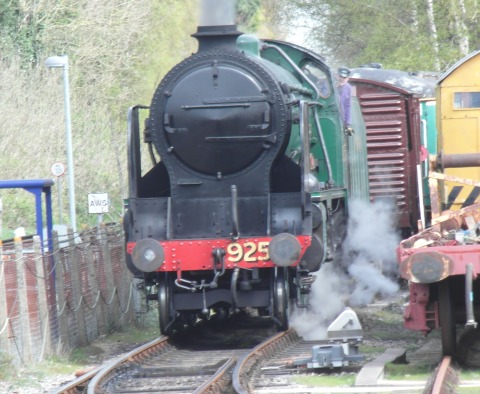
The era of steam trains is long gone. Too slow. Too expensive. Too environmentally unfriendly. Too resource intensive. Too unwieldy. Too dirty. Too clumsy. Too… you name it…
What remains are down to nostalgia and steam engine enthusiasts.
Like my dad. He was a ‘railway man.’ He worked on the railways making sure tracks, signals, power and the like worked so the trains on his watch could run.
He was good at getting ‘things’ to work: trains, cars, tractors, toys, washing machines, cookers, sewing machines, knitting machines, lawn mowers… Are there still men like that around?
In my mind, my dad and trains are synonymous, part and parcel of the landscape of my youth. When I was five years old, I travelled with my Grandparents from Cape Town to Bloemfontein on the overnight sleeper train – the famous (or infamous), Trans Karoo powered by one of those great steam giants.
Oh, the excitement! I loved to put my head out of the window to look for the trail of steam from the engine, see it curve around the next bend with the carriages trailing behind it and feel the rush of wind on my face.
My poor grandparents had their hands full: ‘Don’t look towards the locomotive. You’ll get soot in your eyes! Look the other way.’
Well, did I listen? Of course not! It was no fun looking the other way!
So yes, with memories like that, I am always up for a visit to a heritage railway. And that is exactly what we did last Friday. Visit the Watercress line in Hampshire.
The Watercress line
The official name of this heritage line is Mid Hants Railway. It became affectionately known as the ‘Watercress Line’ because of its connection with transporting watercress from Alresford all the way into London.
Like most heritage lines, it was saved from total extinction by a band of enthusiastic volunteers in 1973.
The line first opened in 1977 as a visitor attraction and ran from Alresford to Ropley. By 1985 it was restored all the way to Alton.
Nowadays you can stop off at Ropley where the engine sheds are, to go take a peek at what the enthusiast are busy restoring. Up in the viewing room, there are diagrams explaining exactly how steam engines work and why it makes the familiar chuffing sound.
The WSR and Bluebell
Last summer we visited the West Somerset Railway line in … wait for it… Somerset! A twenty-mile scenic journey with the surrounding countryside as varied as it is beautiful: gently rolling Quantock hills, the distant Exmoor, unspoilt villages and farms nestling in leafy lanes, the cliffs and coast of the Bristol Channel, the imposing Castle at Dunster and Minehead’s seaside charm – a feast for the senses. It makes for a lovely day out and much to be discovered.
My favourite heritage railway is the Bluebell Line in Sussex. The last time we visited, a few years ago now, you could actually go walking among the engines in the shed. As in a museum, each engine had a note attached to it explaining its history: where it was built, what it was designed and used for, when it came out of service, how heavy it was and the load it could pull. It is as though each of these steam giants has a personality of its own, an impression further confirmed when you talk to the volunteers who restore and work these beasts. They talk about the engines as you would about a beloved pet.
All round Fascination
Watching the visitors at these heritage railway lines is entertainment in itself.
Almost everyone wants to peek into the cab to see the fire. At the end-of-line station, a crowd always gathers to watch the locomotive being uncoupled from the carriages so it can be shunted to the other end of the train for the return journey.
If there is a bridge to serve as an observation platform, a number of people will position themselves there for a better view, watching the engine being shunted past the carriages, past the junction that will bring it in line again with the carriages and finally back to the carriages for the coupling, ready for the return journey. It is mesmerizing. I have done it myself.
There is nothing rushed about a day out like this. You watch. You get on the train. Everyone is happy, full of smiles and expectations for what’s in store. The train chuffs at about twenty-five miles an hour to the next station, stops to drop off and pick up more passengers, chuffs on again and so on till it reaches the end of the line.
There the locomotive is turned around. That probably takes twenty minutes or so. Then it sets off again. Up and down the line it goes, a few times a day.
If you have planned your day well, you will have time to wander into one of the villages along the way for another excursion, lunch or to just amble about. Just make sure you catch the last train back to your starting point!
Keeping it rolling
Meantime, back at railway operations, someone is making sure the workhorses for the day have enough water, coal and everything else it needs to keep them rolling and chugging along with that familiar sound: “Choo….. choo…. choo… choo choo-choo-choo.”